Cost
What affects timber fencing cost
We do not publish per-metre prices, and any timber fencing website that does is quoting a fence it has not seen.
7 min read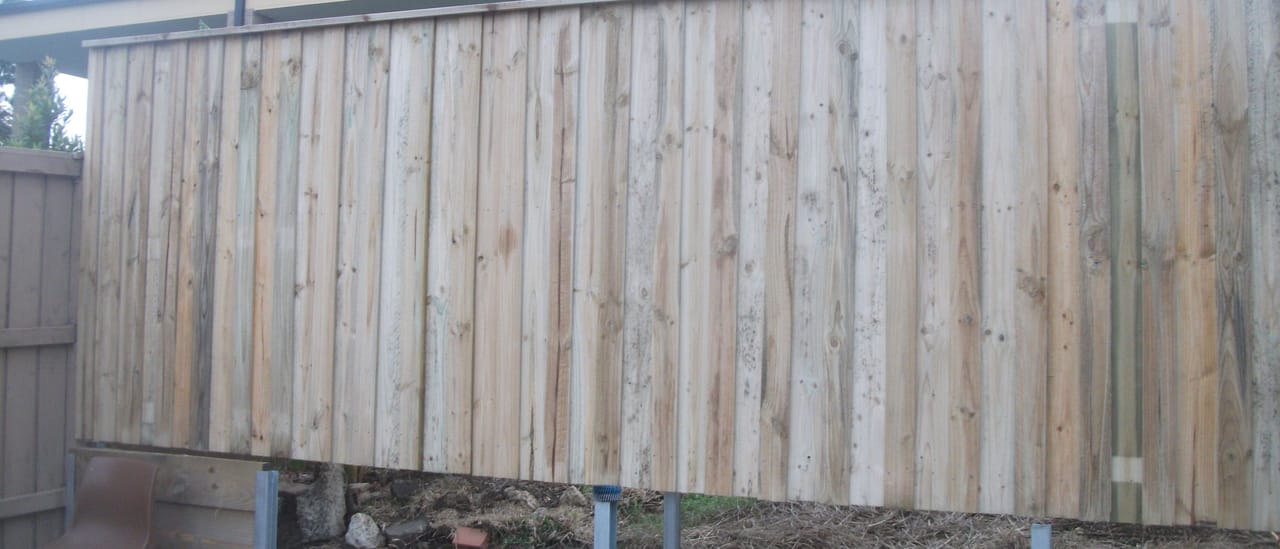
You do not need to be precise. You need to be roughly right, and you need to describe the shape of the job correctly.
A length that is out by a metre is fine. A boundary described as one straight run when it is actually three runs with a corner and a gate is what causes problems.
Walk the fence line and count your paces. An adult pace is close enough to a metre for an initial estimate, and it is far better than guessing from memory.
If you have a tape or a phone measuring app, use it, but do not let the lack of one stop you enquiring.
A boundary of 40 metres could be one long straight run, or four 10 metre runs around a corner block with two gates. Those are different jobs, because corners and gate openings both need posts and framing.
The clearest way to describe it is run by run: "18 metres along the rear, then 12 metres down the left side, then a 1 metre gate, then 4 metres to the house."
Note each gate separately: roughly how wide the opening is, and what it is for.
If the ground falls along the fence line, say so and describe it roughly: a gentle fall, a noticeable slope, or steep enough that you would notice walking it.
Slope affects whether the fence steps or rakes, and it affects the setting out, so it is worth mentioning even approximately.
Photos do more than measurements to make a quote accurate. Five or six from your phone is plenty.
You do not need to know your fence style, your paling count, your post spacing or your rail configuration. That is our job.
You do not need survey-accurate boundary dimensions. The boundary gets measured properly at the site visit.
And you do not need to know what you want. The quote form has an option to say you would like advice, and describing the problem is more useful than guessing at the solution.
Roughly right is fine for an initial estimate. Counting paces along the fence line is close enough. The boundary is measured properly at the free site visit.
Yes, include them in the total and also note each gate separately with its rough width, because gates need their own framing and posts.
Say so. The quote form has an option for exactly that, and describing what you are trying to achieve is more useful than guessing at a style.
We do not publish per-metre prices, and any timber fencing website that does is quoting a fence it has not seen.
7 min readThere is no single best timber fence. There is a best fence for your boundary, and the honest way to get to it is to work through what the fence actually has to do.
6 min readA timber fence looks simple once it is up, which is exactly why a badly built one is so obvious. The line wanders, the top steps unevenly, the posts move within a few years.
6 min read
Once you know what you want, Jye Fulton will measure the boundary and quote it. There is no charge for the visit.
NSW Fencing Licence 269038C · ABN 76 612 245 594